



The Northern Spectacled Salamander (Salamandrina Perspicillata) is an amphibian endemic to Italy, instantly recognizable by the pale markings around its eyes that define its visual identity. It inhabits cool, moist environments where water, stone, and vegetation create stable, sheltered conditions. The species is most commonly found in highland plateaus, mediterranean forests, and terrestrial limestone cliffs, favoring shaded zones with minimal human disturbance. Its behavior is cautious and reserved, characterized by slow movements punctuated by sudden bursts of speed. This salamander is deeply connected to the ecological balance of its native biome.
Salamandrina Perspicillata is closely tied to small-scale terrestrial and semi-humid microhabitats. In upland regions, it relies on springs, streams, and organic-rich soils where moisture remains consistent throughout the year. Within the mediterranean forest, it shelters beneath fallen logs, stones, and leaf litter, actively avoiding direct sunlight. In terrestrial limestone cliffs, it occupies rock crevices and cavities that retain cool, humid microclimates even during drier seasons.

The behavior of the Northern Spectacled Salamander reflects a survival strategy built on discretion rather than dominance. It is neither territorial nor aggressive, but a quiet presence that moves in harmony with the landscape. Its activity patterns are strongly linked to humidity and environmental stability, making it a reliable natural indicator of ecosystem health. Where this species thrives, habitats tend to be intact, continuous, and only minimally altered by human activity.
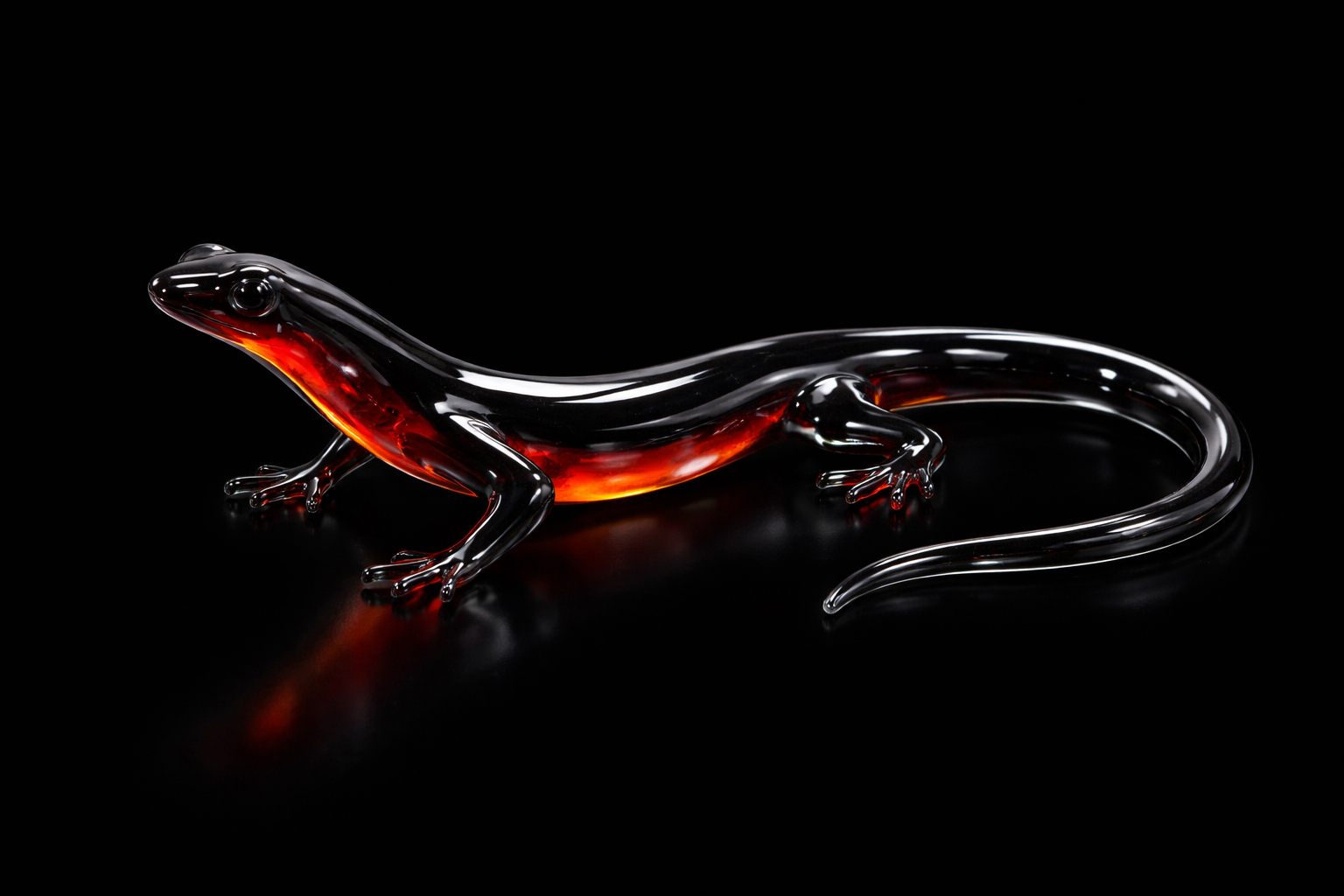
Reimagined as a Murano glass sculpture, the Northern Spectacled Salamander becomes a study in essential form and fluid continuity. The body translates into a smooth, uninterrupted glass volume, with soft transitions that echo the animal’s restrained movement. The pale eye markings emerge as opaline inclusions suspended within the glass mass, serving as both structural and symbolic elements. Rather than imitating biological texture, Murano glass suggests balance, stillness, and adaptation, transforming the species into a refined visual icon.

This Murano Glass Northern Spectacled Salamander is a Concept Art piece from the Animals species. (Amphibians)
The Northern Spectacled Salamander inhabits biomes such as: Highland Plateaus, Mediterranean Forest, Terrestrial Limestone Cliffs. See all (Biomes).

Leave a Reply