


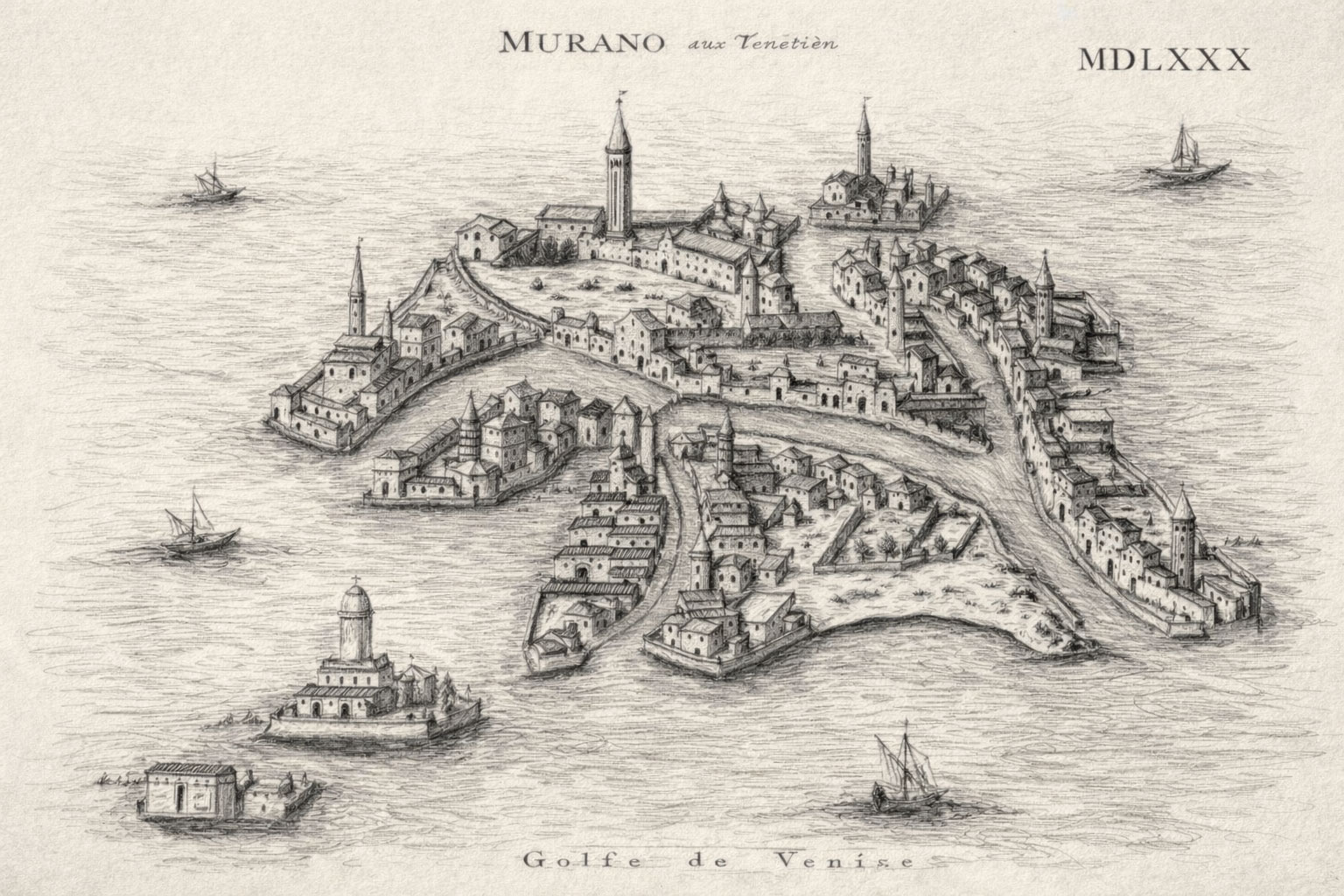

The history of Murano glass is a journey that spans thousands of years, shaped by technical mastery, artistic experimentation, and an unbroken artisan tradition. Long before becoming a symbol of Venice and Italian excellence, glass was already one of the most fascinating and complex materials ever worked by human hands. Murano represents its highest expression, but not its beginning.
Glass Before 1,000 Years Ago
The story of glass begins long before Murano. The earliest forms of man-made glass date back more than 4,000 years, originating in Mesopotamia and ancient Egypt. At the time, glass was used mainly for small decorative objects such as beads, amulets, and ceremonial items. It was not yet the clear, transparent material we recognize today, but rather a dense, opaque substance, often colored using natural mineral oxides.
During the Roman era, glassmaking underwent a major technological leap. The invention of glassblowing around the 1st century BC made production faster and allowed for lighter, more varied shapes. The Romans spread glassmaking throughout the Mediterranean world, producing windows, containers, and everyday household objects. After the fall of the Roman Empire, much of this knowledge was lost in Western Europe, but key techniques survived thanks to ongoing exchanges with the Byzantine and Islamic worlds, where glassmaking continued to evolve.
The Origins and the Move of the Glass Furnaces
In Venice, glassmaking regained momentum between the 8th and 10th centuries, driven by the city’s strategic location and its extensive trade networks. Early glass furnaces operated within the city itself, but the constant risk of fire posed a serious threat to Venice’s largely wooden urban fabric.
In 1291, a decisive move changed the course of glass history: all glass furnaces were relocated to the Island of Murano. This decision served two purposes. On one hand, it protected Venice from devastating fires; on the other, it allowed tighter control over glassmaking techniques and trade secrets. Murano became a highly specialized and closely guarded production center, where knowledge was passed down orally from master glassmakers to apprentices.
This isolation led to an extraordinary concentration of skills and innovation, transforming Murano into a permanent laboratory of glass artistry.
The Golden Age of Murano Glass
Between the 14th and 16th centuries, Murano entered its golden age. Murano Glass Masters developed groundbreaking techniques that made their work renowned across Europe. Among their greatest achievements was cristallo, an exceptionally clear and pure glass that remained unmatched for centuries. Alongside it came refined techniques such as filigree glass, millefiori, lattimo glass, and early forms of complex color layering.
Murano glass was no longer merely functional, it became a luxury object, a symbol of wealth, power, and cultural prestige. European courts commissioned Murano glass for banquets, ceremonies, and private collections. Glassmakers enjoyed rare privileges, yet they were also bound to the island to prevent the spread of closely guarded techniques.
This balance between protection and control allowed Murano to maintain its dominant position in the world of artistic glass for generations.
Murano Today: A Living Tradition
Today, Murano is not a frozen legacy, but a living tradition. Historic techniques are still practiced in active furnaces, often combined with contemporary artistic experimentation. Murano glass has expanded into sculpture, modern design, and conceptual art, engaging in dialogue with international architects, artists, and designers.
In a global market flooded with industrial production and imitations, Murano continues to stand apart through handcrafted workmanship, direct control over molten glass, and a deep connection to its own history. Every authentic piece reflects time, experience, and human sensitivity, qualities that mass production can never truly replicate.
The history of Murano glass, therefore, does not belong solely to the past. It is a story that continues every day, in the glowing furnaces of the island, where fire still shapes matter, and preserves its memory.
Return to the main page: Murano Glass Heritage.
All main articles: Murano Glass Heritage (11).

Leave a Reply